"Make no little plans; they have no magic to stir men's blood and probably will themselves not be realized. Make big plans; aim high in hope and work."
— Daniel Burnham, architect & city planner, London 1910
Today's session surfaced something important: thinking big and feeling big are not the same thing — and you need both. Thinking big is a cognitive act; feeling big is an identity act. One changes your plans. The other changes you.
Expanding the scope of what you believe is possible — and then planning from that expanded horizon.
Embodying the identity of the person who already lives at that scale — before the results arrive.
From the whiteboards today — eight distinct reasons why thinking bigger isn't just ambition, it's responsibility.
The version of you operating today is almost certainly not the ceiling. Most entrepreneurs never find out where the ceiling actually is.
Thinking small and thinking big both require your full energy. The gap is in the direction you aim it — not the amount.
Every leap forward in business, medicine, infrastructure, and culture came from someone who refused to make little plans.
The risk isn't only in going big. Staying small has its own exposure: irrelevance, talent loss, and a business that can't outlast you.
More resources don't just mean more comfort — they mean more extraordinary experiences created for people you love and customers you serve.
The real leverage of thinking big is the ripple: communities, industries, and lives you'll never directly touch but will change anyway.
What you build now — the culture, the company, the vision — will outlive every decision you make this quarter. Build accordingly.
Retention, morale, and purpose inside your business are directly tied to whether the people inside it feel they're part of something meaningful.
Today's session didn't happen in a vacuum — these frameworks connect directly to the concepts on the whiteboards. Each one is worth going deeper on.
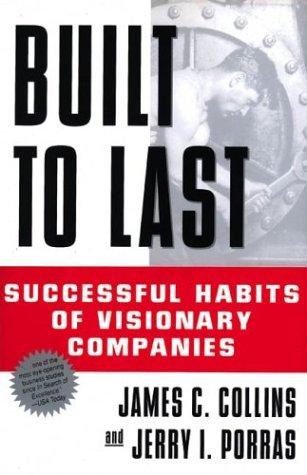
Jim Collins & Jerry Porras showed that visionary companies set goals so audacious they feel almost unreasonable — and that this is the point. A BHAG isn't a 3-year plan; it's a 10–25 year north star that filters every decision underneath it. Companies with BHAGs outperformed comparison companies at more than double the rate.
Connection to today: Your BHAG should feel unachievable from where you stand now. If it doesn't make you slightly uncomfortable, it's not big enough.
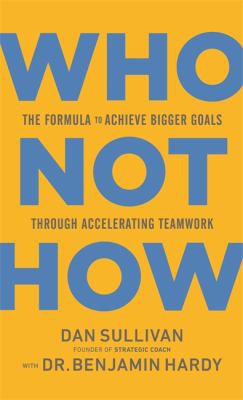
Dan Sullivan's central insight: every time you ask "how do I do this?" you limit yourself to your own capabilities. The instant you ask "who can do this?" you unlock exponential leverage. Freedom — of time, money, relationship, and purpose — comes from building the right team, not from doing more yourself.
Connection to today: The "Avenues of Growth" section on the whiteboard — team, RPRS, AI — is all about finding the right Whos so the How stops being your ceiling.
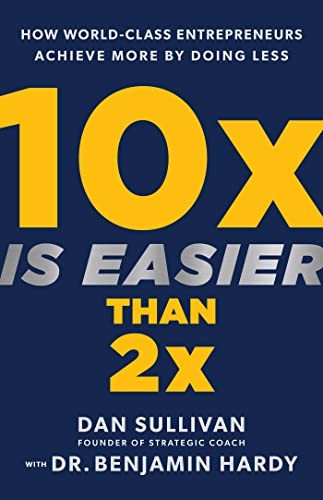
The counterintuitive premise: aiming for 10x growth is actually easier than 2x, because 10x forces you to think and act completely differently. 2x is incremental — you just do more of the same. 10x demands that you question everything, delegate most things, and focus only on what only you can do. It's a qualitative shift, not a quantitative one.
Connection to today: "Same effort as thinking small" from the whiteboard is the 10x principle exactly. The effort is similar — the target, and therefore the transformation, is radically different.

Dr. Benjamin Hardy's research shows that your imagined future self is the primary driver of your present behaviour — not your past. Most people think of their future self as a stranger; high performers treat that future self as real, close, and directive. The practice of "remembering your future" means letting the person you're becoming make the decisions today.
Connection to today: "Remember your future" — the phrase on the personal notes — is the title of Hardy's core practice. Identity shift and Feeling Big both start here.
Thinking big without a pathway stays abstract. These are the practical levers that came out of today's session — each one a concrete avenue to close the gap between your current reality and your expanded vision.
Ask "What is possible?" and "Where do I want to go?" before you ever ask "How?" How is a trap — it anchors you to current capability.
Borrowed from improv: never shut down a big idea with "but." Build on it. "Yes, and what if we went even further?" The idea that survives is usually bigger than the original.
The fastest identity shift is proximity to someone already operating at the level you're aiming for. Find who, not how to figure it out alone.
Big vision needs daily structure. OKRs translate the BHAG into quarterly targets; habits wire the identity into your nervous system before the results appear.
You can't 10x alone. Every Avenues of Growth exercise ends at the same place: you need the right people around you, not more of your own time.
AI is not a productivity tool — it's a force multiplier on thinking. Use it to stress-test your BHAG, generate scenarios, and do the research that used to take weeks.
These questions are designed to keep the session alive — not as a one-time exercise, but as an ongoing practice. Use them at the frequency that fits.
Am I making decisions today as the person I'm becoming — or the person I've been?
Where did I default to "how do I do this?" instead of "who can do this better than me?"
Did I pick up the feeling today — or did I wait for results before allowing myself to feel big?
What one small act today was consistent with my future self — and what one act wasn't?
Where did I play small this week — and what would the 10x version of that decision have looked like?
What limiting belief showed up disguised as a "realistic" reason not to go further?
Which conversations, tasks, or decisions did I hold onto that I should have handed to the right Who?
What does abundance look like in my life right now — and am I actually letting myself experience it?
Is my current BHAG still uncomfortable enough? If it no longer feels slightly unreasonable, it's time to raise it.
What does my life look like in five years if I keep thinking at the level I'm thinking at right now?
Who is one person I should be closer to — someone operating at the identity level I'm working toward?
What trade-off am I still refusing to make that is keeping me anchored to the current version of my business?
If a future version of me — five years from now, operating at full potential — looked back at this month, what would they say I was still being too cautious about?